The UK food and drink sector is facing a new phase of regulation aimed at improving public health and reducing the promotion of less healthy products. What began with in-store restrictions on products high in fat, salt and sugar has now expanded into advertising, with new limits coming into force from January 2026.
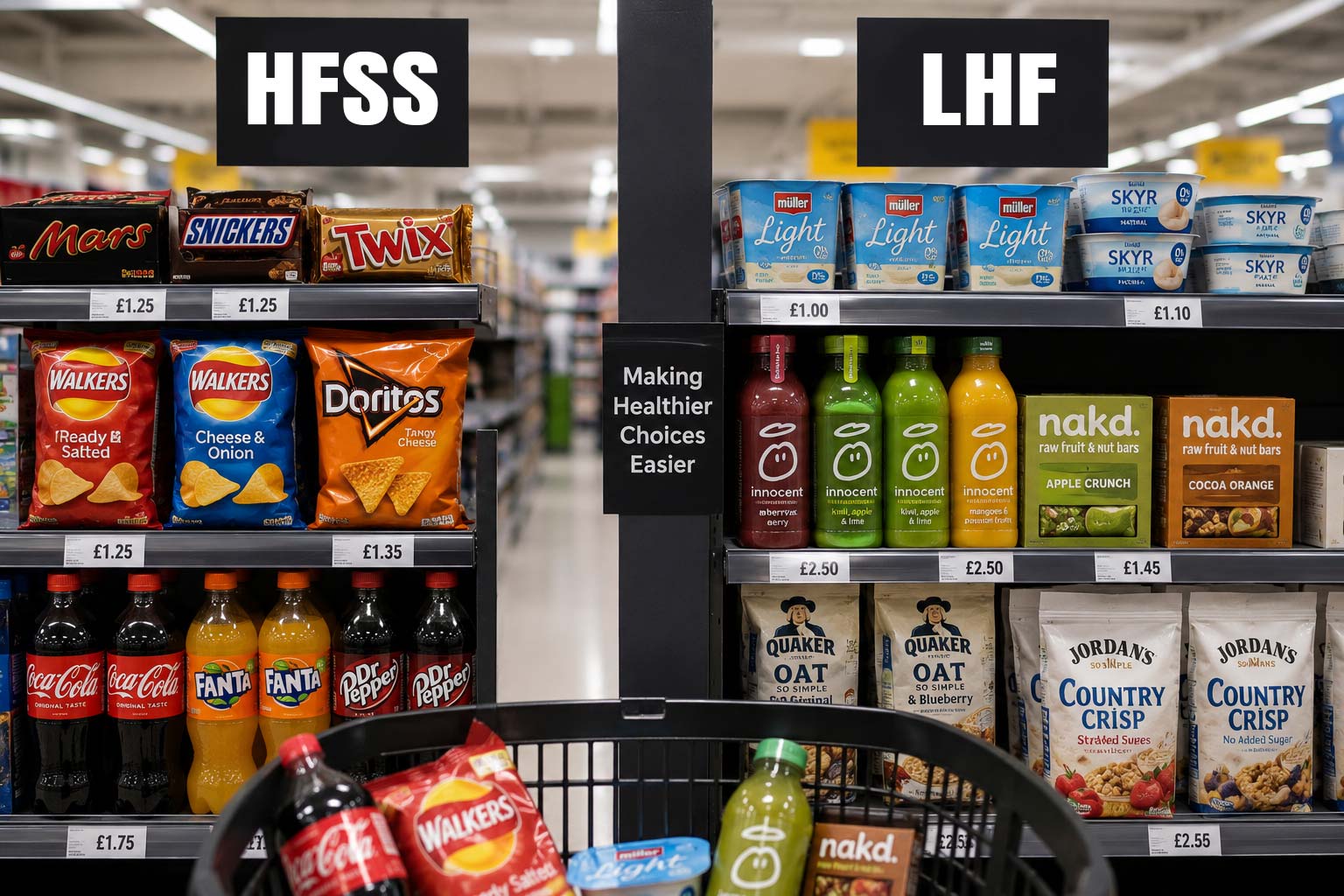
At the heart of this shift are two closely linked — but often confused — frameworks: HFSS (High in Fat, Salt and Sugar) and LHF (Less Healthy Food). While they are connected, they serve different purposes and apply in different ways across retail and media.
As advertising restrictions tighten, understanding the distinction between HFSS and LHF is essential. Getting it wrong can result in non-compliant campaigns or overly cautious strategies that limit growth. Getting it right allows brands to plan, innovate and communicate confidently within the rules.
What is HFSS?
HFSS (High in Fat, Salt and Sugar) is a nutritional classification used by the UK Government to assess the health profile of food and drink products.
It is determined using the Government’s Nutrient Profiling Model, which scores products per 100g based on their nutritional composition.
How HFSS is Assessed
Products are scored using a points system that considers:
- Energy
- Total sugar
- Saturated fat
- Salt
- Positive nutrients, such as:
- Fibre
- Protein
- Fruit, vegetable and nut content
Products that exceed the defined threshold under this model are classified as HFSS.
What HFSS Controls
HFSS classification determines where and how products can be promoted, particularly in retail environments.
Since October 2022, HFSS products have been subject to in-store promotional restrictions, including:
- No placement at checkouts
- No display on aisle ends or other high-traffic locations
From October 2025, additional restrictions will apply to price promotions, including:
- Bans on volume-based promotions, such as buy one get one free (BOGOF) and multi-buy offers
Importantly, HFSS applies regardless of product category. Any product that exceeds the nutritional thresholds is in scope, even if it is not traditionally perceived as unhealthy.
Read more: How to Brief a Packaging Redesign in an HFSS-Regulated Category
What is LHF?
LHF (Less Healthy Food) is a legal advertising classification, rather than a nutritional one.
It was introduced under the Health and Care Act 2022 to regulate how certain less healthy food and drink products can be advertised, particularly online and on broadcast media.
How LHF is Defined
A product is classified as LHF only if both of the following conditions apply:
- The product is HFSS, based on the Government’s Nutrient Profiling Model, and
- The product falls into one of 13 regulated food categories, including:
- Chocolate
- Crisps
- Sugary breakfast cereals
- Ice cream
This means that not all HFSS products are LHF, even if they score poorly nutritionally.
What LHF Controls
Unlike HFSS, which governs in-store promotions and pricing mechanics, LHF focuses solely on advertising visibility.
LHF regulations restrict:
- Paid-for online advertising, which is banned 24 hours a day
- TV and on-demand advertising, which is prohibited before the 9 pm watershed
These restrictions apply to all UK-targeted advertising, regardless of the age of the audience being reached.
Crucially, LHF does not regulate product formulation, pricing, or in-store placement — it determines where and when brands are allowed to advertise specific products.
How HFSS and LHF work together
For a product to be restricted under the new UK advertising rules (effective from January 2026), it must meet both of the following criteria:
- Be classed as HFSS (high in fat, salt or sugar), and
- Fall within one of the 13 defined LHF product categories, such as confectionery, sugary soft drinks, savoury snacks, ice cream, cakes or biscuits
If a product is HFSS but does not fall into one of these categories, it is not considered LHF and is not subject to the same strict advertising bans.
This distinction is crucial. HFSS determines nutritional status, while LHF determines legal advertising restrictions.
Key Differences at aGlance
- HFSS is a nutritional scoring system that assesses the health profile of a product based on its ingredients and nutrient composition.
- LHF is a legal advertising classification that determines whether and where certain products can be advertised.
- HFSS primarily affects how products are sold and promoted in retail environments, including placement and price-based promotions.
- LHF affects where and how products can be advertised, particularly across online, TV and on-demand media.
- A product can be HFSS but not LHF — for example, olive oil, which may score as HFSS but does not fall into a regulated LHF category.
- A product can be both HFSS and LHF — for example, chocolate bars, which are HFSS and sit within a regulated LHF product category.
In short, all LHF products are HFSS, but not all HFSS products are LHF.
Timing and Enforcement
The HFSS and LHF frameworks have been introduced in stages, with different start dates and enforcement mechanisms.
HFSS
- HFSS in-store promotion rules have been in force since October 2022, restricting where less healthy products can be displayed in retail environments.
- These rules will expand in October 2025, when additional restrictions on price promotions—including volume-based offers such as buy one get one free—come into effect.
LHF
- The LHF advertising ban will take legal effect from 5 January 2026.
- Ahead of enforcement, the Government has asked advertisers to comply voluntarily from October 2025, to allow time for adjustment and implementation.
Enforcement
- The Advertising Standards Authority (ASA) is responsible for enforcing the LHF advertising rules once they are live.
- In cases of serious or repeated breaches, the ASA can refer advertisers to Ofcom, which has the power to impose financial penalties.
Why Brands Need to Understand Both
HFSS and LHF operate at different points in the marketing and retail ecosystem, but together they shape how brands can bring products to market.
- HFSS influences product placement and promotional mechanics, determining where items can appear in-store and how they can be promoted on price.
- LHF reshapes media strategy and creative execution, dictating when, where and how certain products can be advertised across online and broadcast channels.
Failing to distinguish between the two can have real consequences. Confusion can lead to:
- Ads being banned or withdrawn, even when the underlying product is compliant in other contexts
- Over-cautious marketing approaches that go beyond what the law requires, unnecessarily limiting visibility, creativity and growth
Brands that understand both frameworks clearly are better placed to stay compliant without sacrificing commercial impact—using each set of rules as a guide for smarter planning rather than a constraint.
Read more: HFSS as a Growth Opportunity for Mid-Size Food and Drink Brands
Strategic Takeaway
HFSS tells you what a product is from a nutritional standpoint.
LHF determines how, where and when you can talk about it from an advertising and media perspective.
The most successful brands will be those that see these frameworks not as barriers, but as strategic guardrails. They will:
- Innovate within HFSS constraints, through reformulation, portion control and smarter product design
- Use LHF restrictions to rethink storytelling, shifting tone, language and creative execution to focus on broader brand values rather than product push
- Move from visibility-led marketing to trust- and benefit-led engagement, building long-term relevance with consumers who increasingly expect transparency, responsibility and health-conscious choices
In a more regulated landscape, growth won’t come from shouting louder — it will come from communicating smarter.