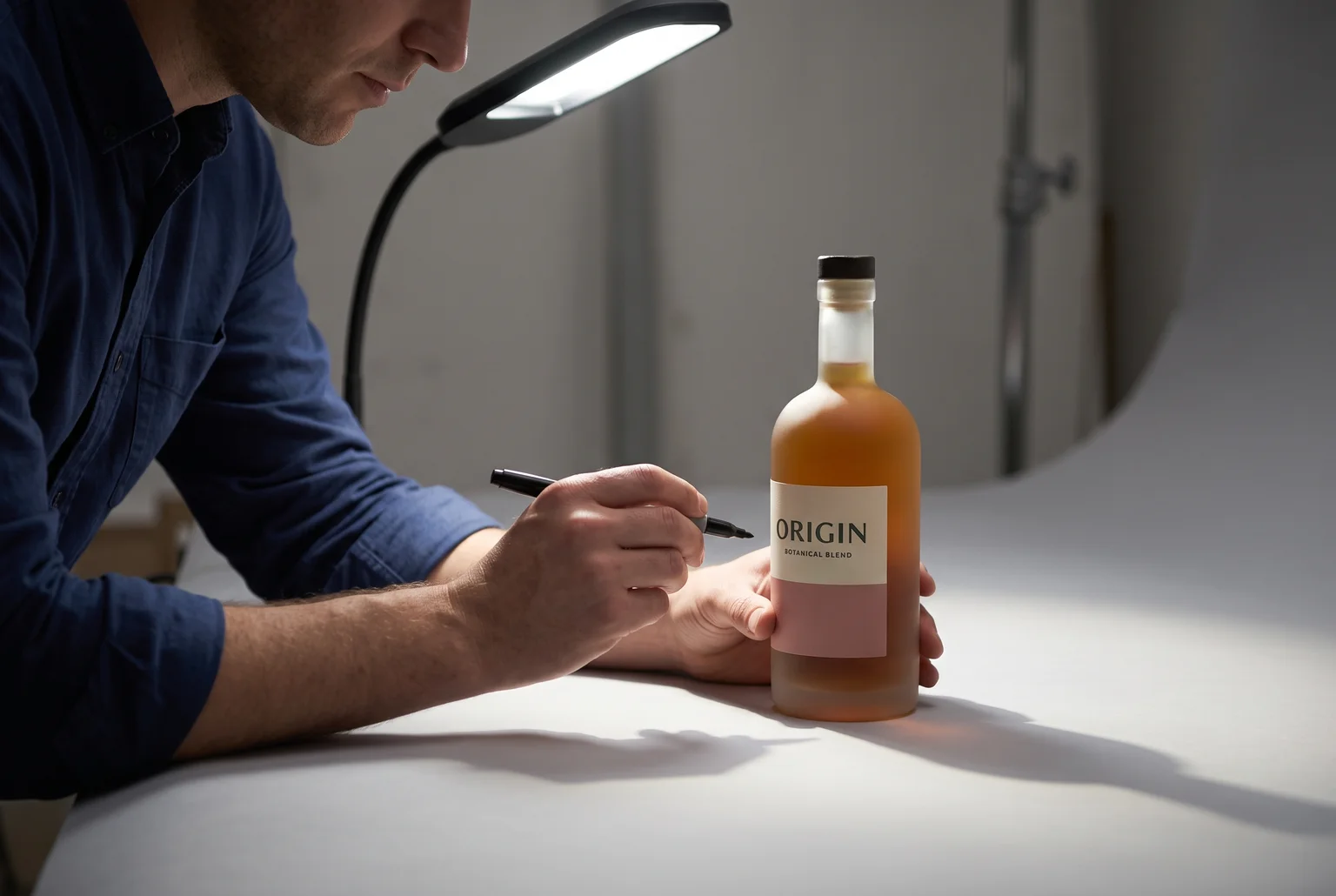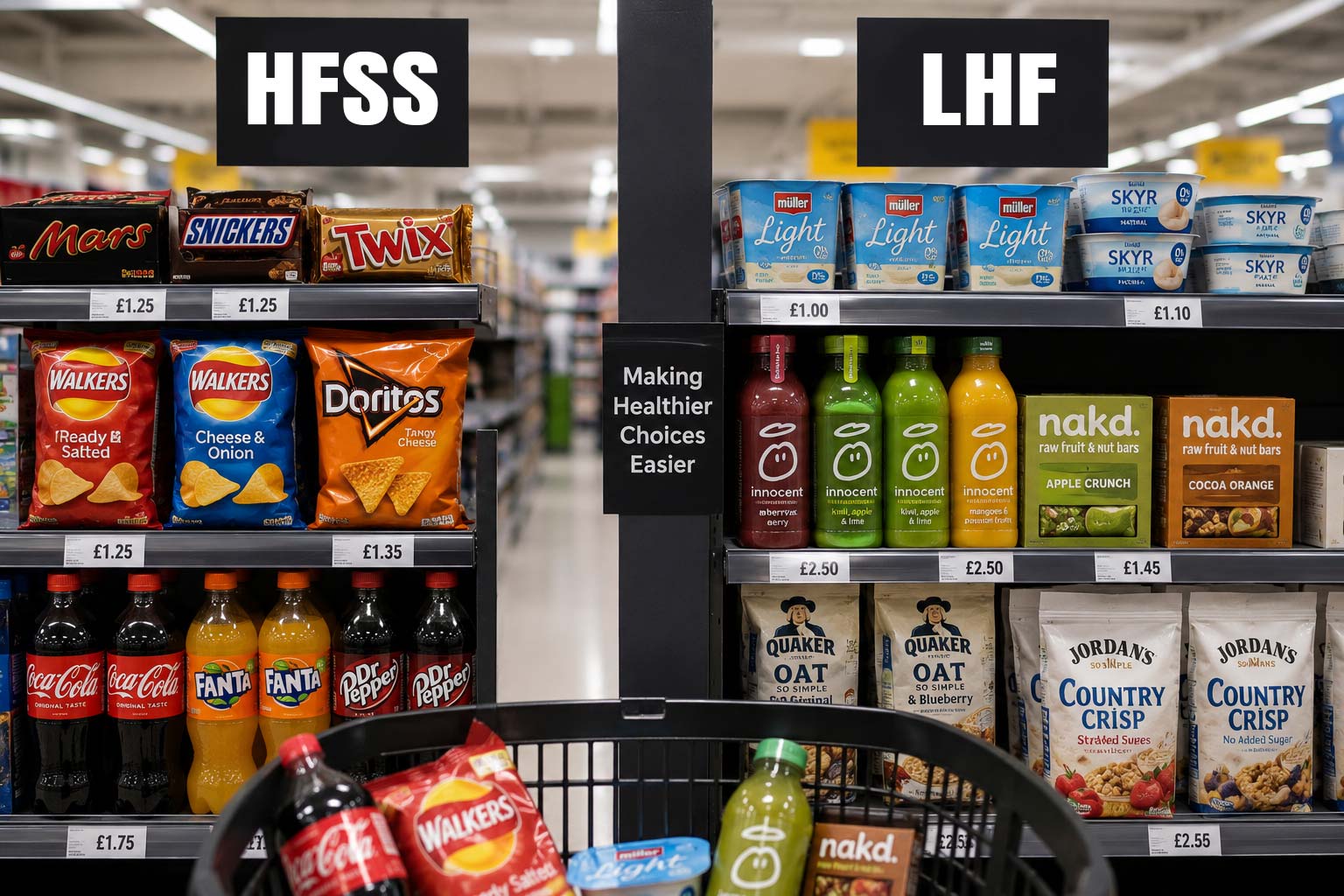
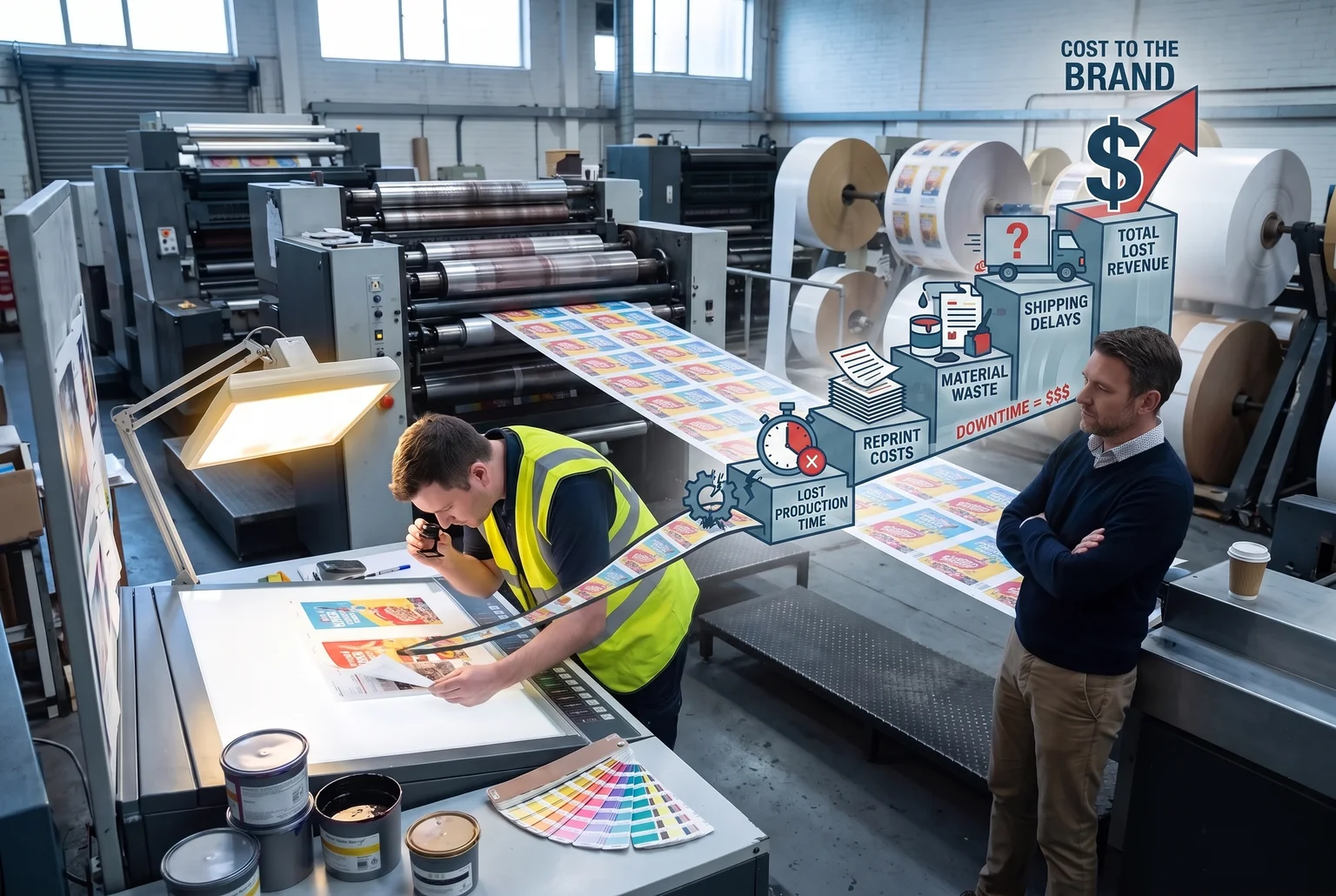
The mistake that actually burns your budget
Your redesign fee is not the number that will hurt you. Hiring a team that has never wrestled with a print run is. When the artwork hits the press and the problems start, inexperience in packaging production is what drains your money.
If you are a UK challenger brand looking at a range review and trying to work out what a redesign should cost, you have probably already been quoted a design fee and treated it as the number that matters. It usually isn’t.
Most UK general graphic design and marketing agencies quote packaging in the low thousands of pounds, commonly £1,500 to £10,000 and up depending on scope. Many big brand agencies charge in excess of £25,000+ for the big idea and rebrand, with complex ranges exceeding £250,000.
For founders the figure feels real, and it is worth getting right. But the amount you commit downstream, in print runs, tooling and stock, dwarfs it. So does the cost of putting the wrong well-designed pack into the market and seeing your sales struggle.
Nine times out of ten, when a founder tells me a project went badly, the design itself isn’t always the problem. What failed was upstream or downstream. The brief pointed at the wrong problem, so the work solved something that didn’t move sales. Or the rollout ignored how the range actually blocks on shelf. Or nobody stood at the press check, and the first pallet came off looking nothing like the signed-off artwork.
UK-facing guidance tends to stop at the design fee, because most of it is written for smaller studios and one-off SME briefs. US-facing material jumps straight to enterprise programmes running into tens or hundreds of thousands of dollars. Established challenger brands sit in the gap between those two, with real retail stakes and no procurement guide written for their level.
That gap is why this piece exists. The rest of it separates what you pay an agency for from what you commit to a printer, then shows where the money genuinely gets burned.
The agency fee and the print commitment should be treated as two different pots of money
Two budgets sit inside every redesign, and they behave differently. One is what you pay an agency for thinking, direction and press-ready files. The other is what you commit to a printer or converter for tooling and stock. Founders who treat them as one number tend to make the wrong call on both.
The agency side buys the work: diagnosis, brief, concepts, artwork. The printer side buys physical things. Origination and plates, the sleeves that hold the image on press, and the units themselves. Converters bill these on the manufacturing quote, separate from any design fee, and they set the terms.
Flexo, which most food and drink packaging runs on, has a high setup cost and a low running cost. You pay for a plate per colour, commonly £30 to £150 each on corrugated, then the per-unit price falls sharply once volume climbs. That economics is why converters impose a minimum order quantity, often a few thousand units for cartons and ten thousand or more for flexible film. You pay for the whole MOQ whether you sell it or not, and if you get the balance wrong you can be tied up with multiple years worth of stock.
That last point is where conflating the two budgets does real damage. A brand looking at a single quoted figure will often trim the design work to protect cash, then commit to a large print run without noticing the working capital it locks up. The plates are a one-off. Get the design right and they carry across repeat orders at no further origination cost. The stock is the recurring commitment, and it is usually the bigger number.
So separate them before you compare anything. The agency fee is a one-time cost for getting the direction and files right. The production commitment is a rolling exposure set by your printer’s MOQ, not by the agency. Judge each on its own terms.
The six stages behind the quote and the one that decides your listing
The agency fee pays for a sequence of work, not a set of visuals. UK packaging agencies tend to run the same six stages, whether they name them or not. Understanding what each one does tells you where a quote is thin.
Diagnosis comes first. Before anyone draws anything, the agency reads the shelf, the category, and the technical constraints your printer will impose. Shelf analysis, trend review and early engagement with the converter happen here. Skip it and you design in a vacuum, then discover the pack does not fit the print process on the manufacturing quote.
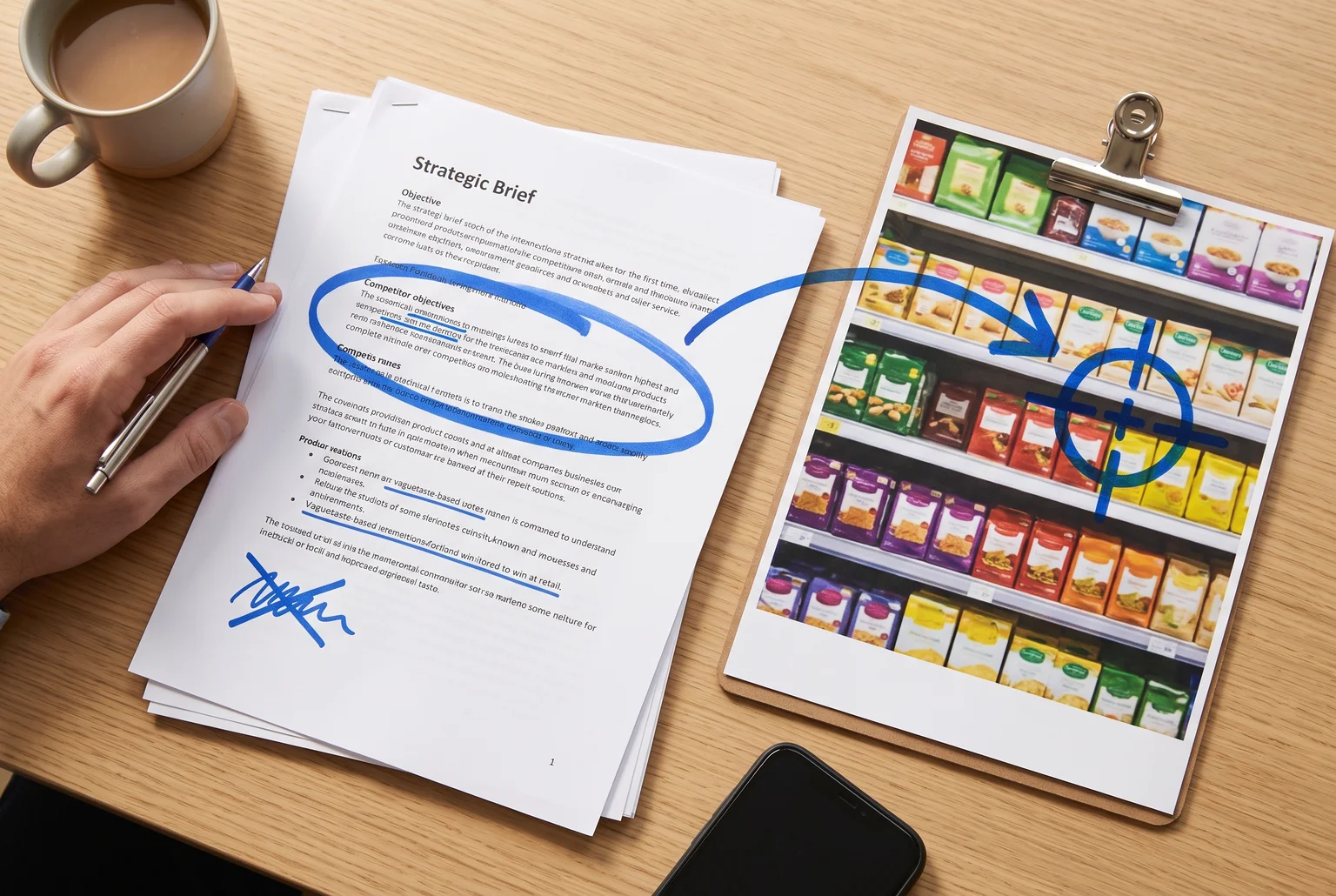
The strategic brief is where most projects are won or lost. A proper brief pins down the commercial objective, the shopper and how they buy, the competitive set, the technical and regulatory limits, and the scope. Get it vague and the agency ends up designing to your taste rather than to the shelf. That is the expensive error, and it is invisible until the pack underperforms in a range review.
Concept development usually produces two or three distinct routes, each with a worked-through hierarchy of what the shopper reads first. Multiple routes are not padding. They are how you test whether the brief holds, rather than polishing the first idea into a corner.
Consumer read is where opinion gives way to evidence. This ranges from qualitative concept feedback to in-context shelf tests against real competitors. Done properly, shelf testing measures pick-up rates, which pack gets chosen first, and where attention lands, often with eye-tracking as a proxy for stopping power. Robust quantitative work uses 200 to 300 respondents per cell to read a 4% sales shift, and can tell you whether a design carries the trade-up from craft to premium you are banking on. It is also the stage most often cut to save money, which is why some redesigns land on shelf as a guess.
SKU rollout planning is the systematising step. Printed prototypes and 3D dummies check legibility and behaviour in the hand, and the design gets built into a system that holds across flavours, sizes and formats without redrawing each one. Weak rollout planning is where consistency quietly breaks across a range.
Production support closes it out. The agency prepares print-ready artwork, handles prepress and supports the press, matching colour on the day and catching problems before the run commits. This is the handoff, and it is worth as much as the concept.
Notice the pattern. The design fee itself is rarely the number that hurts. A thin brief, a skipped consumer read, or a loose handoff costs far more, and none of them shows up as a line you can see.
What the starting figure tells you about the scope
A starting figure is only useful if you can see what sits behind it. UK agencies that quote well tie the number to a defined scope, not to a fixed menu, so you could be quoted three different ways depending on what the work actually needs.
We have three illustrative starting points, and treat them as scope examples rather than a price ladder.
Around £6k is a starting budget for a single SKU project where the branding work is already done. The founder has a recent refresh they are happy with, so there is no brand workshop and no consumer testing in their budget. We are applying settled thinking to pack, sorting hierarchy and getting the artwork production-ready. That is the leanest version of our Confident to Shelf™ engagement, and it only holds if the brief genuinely is settled.
Around £9k includes the branding workshop which is the best starting point to build strong foundations for the refreshed pack. Rather than assuming the direction, our agency runs the discovery that defines the brief before any concept is drawn. Workshops work as scope-defining discovery, not a bolt-on, which is why the figure moves when they are included. They deliver a huge amount of value to your brand and lead all decisions as the project moves through the later phases.
Around £12k typically adds consumer research on top of that. You are paying for evidence that the pack does the commercial job before it commits to a print run, whether that is qualitative concept feedback or an in-context shelf test against the real competitive set. The data gives you and retailers confidence that the right decisions are being made during the refresh.
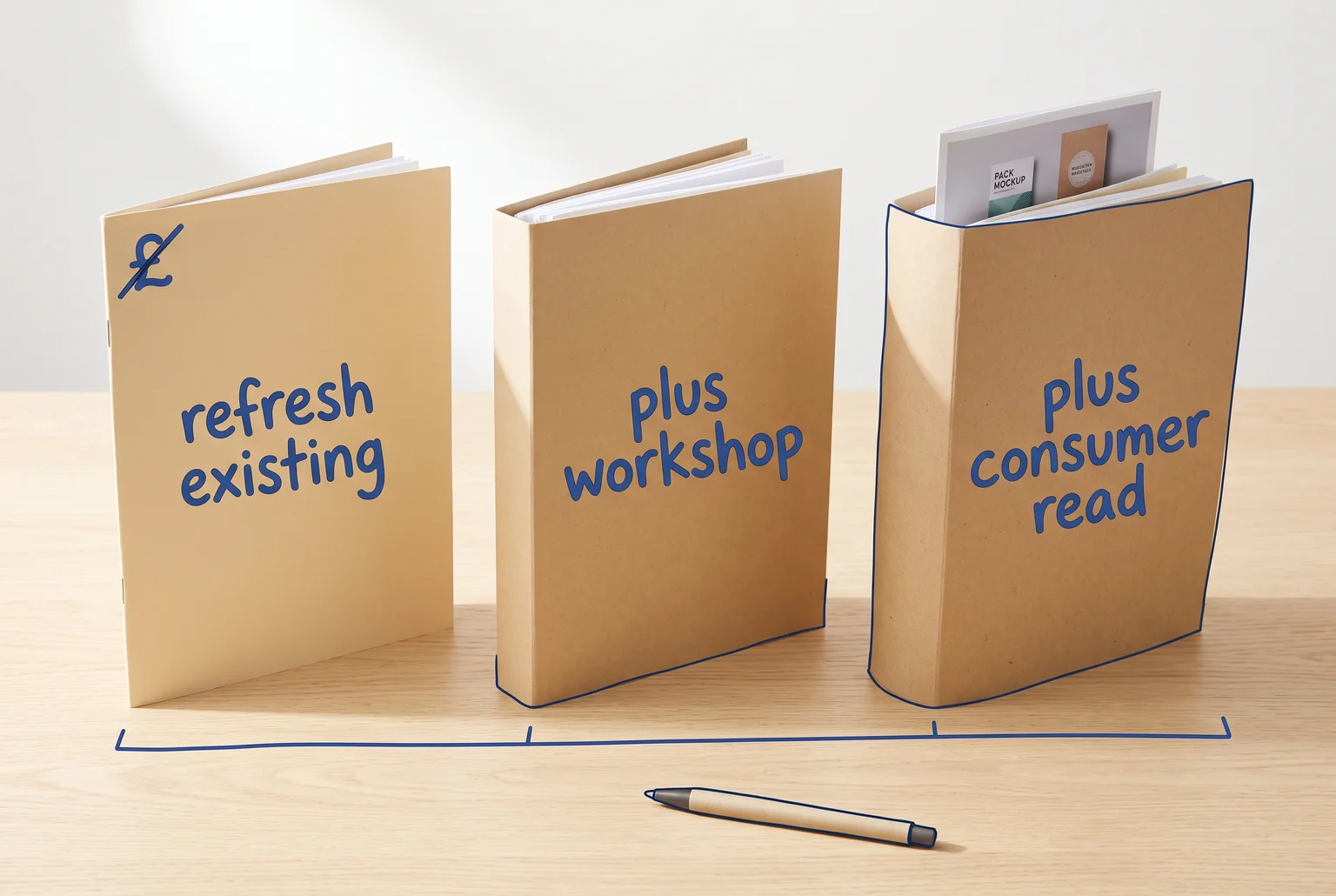
None of these are the price of your project. They are markers for what changes the number: whether the brief needs building, and whether you want the design read before it goes to press. A quote that names a figure without naming which of these critical areas it covers is not really worth considering.
However, the variable that moves the number most is not any of these three. It is how many packs the system has to hold, which is the next thing worth understanding properly.
What actually moves the number: range complexity
The number moves with how much the system has to hold and how varied it is, not just a headcount of packs.
What the agency is really building for a range is architecture: a packaging system that decides what stays locked across every pack (logo, layout grid, core typography) and what flexes per variant (colour, name, flavour icon). A system built for a handful of SKUs but never planned for the full range will break as the range grows. So the architecture has to be planned for where the range is going, not just what sits on shelf today.
The master thinking is created once. Then each variant multiplies the application work: more artwork adaptations, more nutrition and claims copy to manage, more proofing rounds, more printer setup. That is where the effort scales, and format variation scales it harder. A range that runs across pouches, cartons and shrink sleeves is a bigger job than the same number of variants in one format, because each format carries its own production rules.
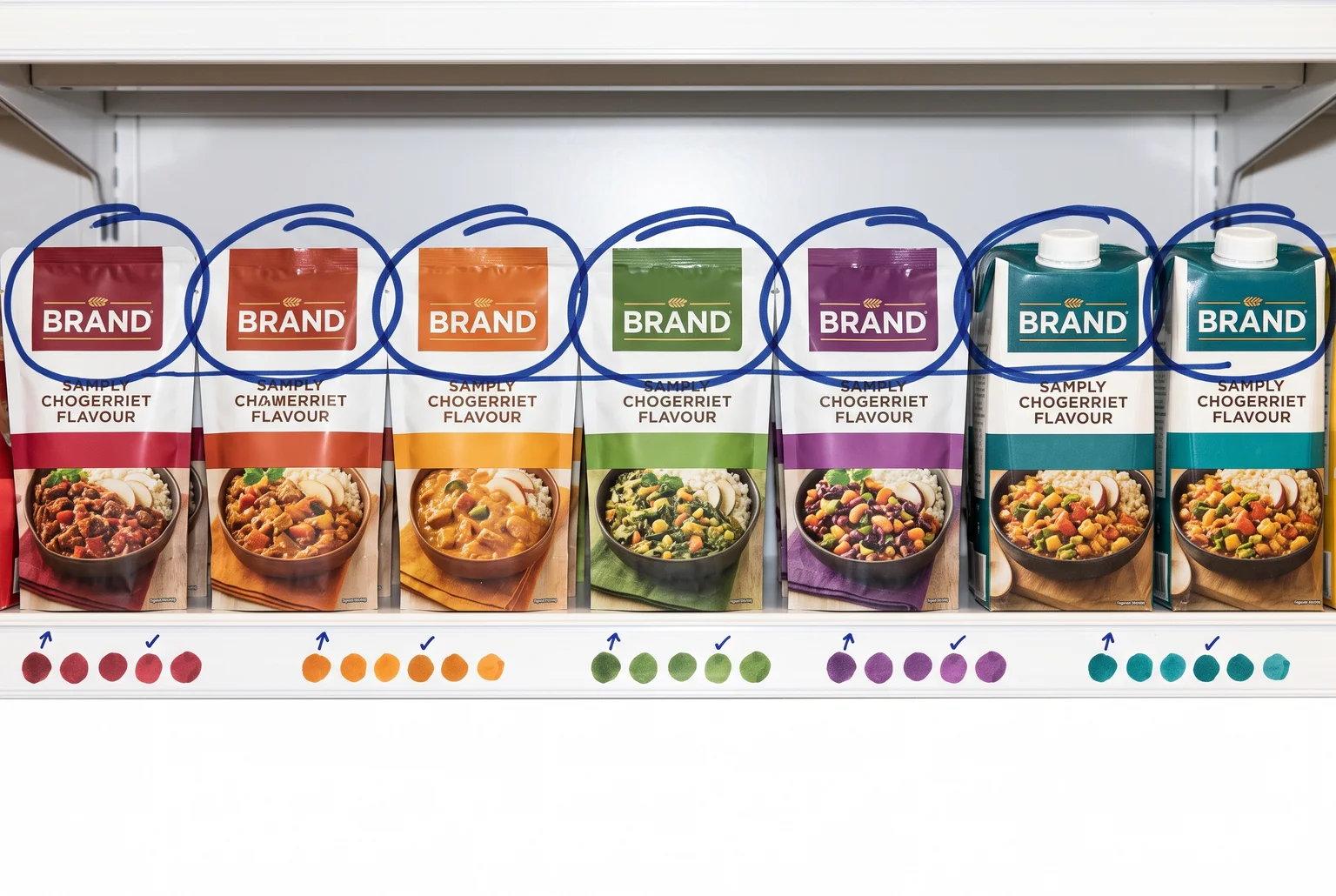
Done properly, the architecture pays for itself as the range grows. New lines slot into decided slots rather than triggering a fresh design round each time. Large UK grocery rebrands built on a coherent range system have been reported to lift sales, and the mechanism is the same at any scale: decision trees mean new products plug straight in.
For a first stage of support, that means the honest scoping question is the shape of the range over the next two to three years, not the number sitting on shelf today.
The costs that hurt the most come after sign-off
The design fee is a known, one-time number. The costs that can genuinely hurt a founder come after the files are approved, when the pack meets a printer, a range review calendar, and a retailer’s contract.
Start with the calendar, because it is the least visible and the most punishing. UK grocery buyers reset shelves in fixed windows, often only once or twice a year per category. Miss the artwork or data cut-off for that window and the next one can be six to eighteen months away. Some categories review only annually, so a slow production sign-off can cost you a full year of grocery revenue while a competitor takes the facing you were aiming for.
Most retailers keep the exact dates internal, so you confirm timing through the buyer or the portal, not by guessing.
That is why the press check matters more than founders expect.
Reprints are rarely caused by the print technology. They come from artwork and file preparation, colour and substrate mismatches, and regulatory copy errors: wrong colour build, a Pantone that was never specified, an allergen line that slipped, a barcode set up so it will not scan on the till. A press check and proper proofing are the control steps that catch these before a full flexo run commits.
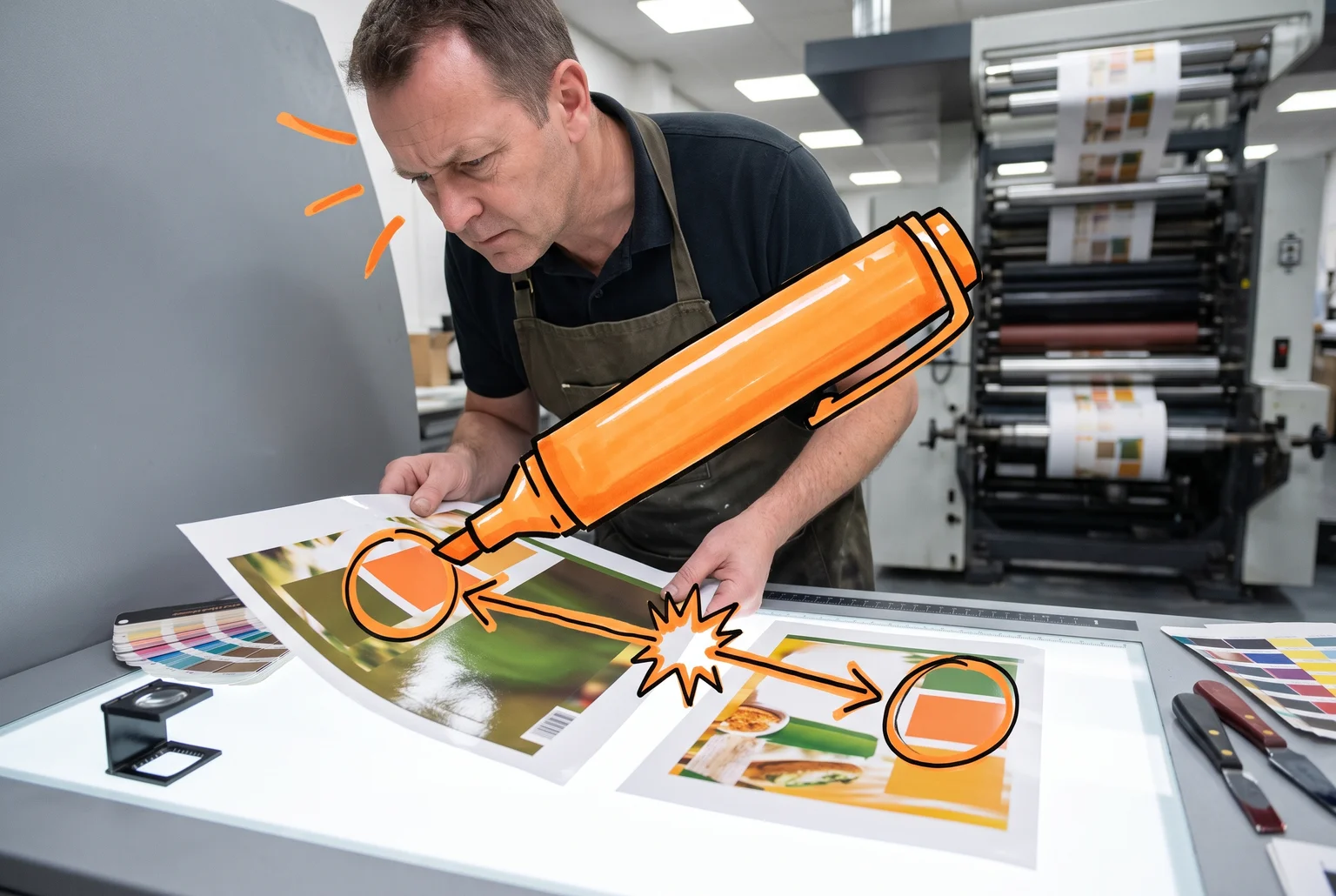
Get it wrong and the bill lands in several places at once. The obvious one is the reprint and scrapped stock. The less obvious one is the retailer. Because a supermarket carries legal exposure if your pack misleads a shopper or requires a recall, their supplier terms let them recover the cost from you. That means chargebacks for re-stickering and re-labelling, system corrections, and administrative time. In the worst cases they pull the product, suspend the order, or mark you down for the next review.
The regulatory floor underneath all this is real. Under section 20 of the Consumer Protection Act 1987, misleading price indications are a criminal offence, with unlimited fines and up to two years’ imprisonment for serious cases, and civil penalties can reach £300,000 or 10% of turnover. Most packaging errors never get near those numbers. They do not need to. A re-stickering charge across a national listing, plus a missed window, is already a multiple of what the design cost.
None of this shows up in the agency quote. It shows up when a founder treats production support as an optional extra and signs off artwork without a press check to protect it. That is the line item worth defending.
Read the quote for the process, not the price
A quote that only describes deliverables is describing a design fee. A quote that describes a process is describing the thing you actually need. Read for the second one.
Look first for a diagnosis or strategy phase written into the scope. If the document goes straight from brief to concepts with no research, workshop, or competitive read in between, you are paying for aesthetics and hoping they land. That is the most common way a high fee buys a weak result.
Check how concepts are handled. A serious proposal states how many initial routes you get, ties each to a strategic idea, and says plainly how many revision rounds are included and what an out-of-scope change costs. Vague revision language is where budgets drift after sign-off.
Consumer testing should be named, either in or out. If it is included, the quote should say what is being measured and how. If it is excluded, that should be a stated decision, not a silence you discover later.
Then the part most founders skip reading: production support. Confirm the agency provides print-ready files and dielines, and that someone will speak to your printer during proofing and the first run. Ask directly whether the team has managed print production for brands at your scale, and ask for a walkthrough of one recent project from brief to press run.
The portfolio test is quick. Ask to see on-shelf photos of produced packs, not concept visuals, with notes on the materials, the print process, and how they handled colour limits or a substrate problem. An agency that has stood at a flexo press will have those notes. One that has not will show you renders of products which don’t exist in the real world and never made it beyond a screen let alone near a printing press.

Nine times out of ten, the cheaper headline fee is only cheaper because the risk has been pushed into your tooling, your stock, and your rollout, where it costs more and shows up later. A quote that includes the brief, the testing decision, the rollout plan, and the press-check handoff is not the expensive one. It is the one that has already priced in the mistakes you would otherwise pay for twice and reduces the risk and protects your investment.
Sources
- CMS Law, pricing claims guidance
- Express, UK pricing display law reporting
- Consumer Protection Act 1987, section 20, misleading price indications
- UK flexo print and converter guidance on plate and sleeve origination costs and reusable tooling
- Flexo cost guidance on run-length economics and per-unit plate amortisation
- Converter guidance on minimum order quantities and stock commitment
- UK grocery guidance on fixed category and range review windows and the cost of missing the window
- Reporting on the Tesco range rebrand across 9,294 products and reported sales uplift