What extended producer responsibility means for a food or drink pack
Every pack you put on shelf now carries responsibilities that continue after the shopper has finished what was inside.
Extended producer responsibility (EPR) is the broad principle that the businesses making and selling products should take responsibility for them, or their packaging, once they become waste. Different countries apply it in different ways, and to different product categories.
The UK packaging scheme is one specific version of that principle. It shifts the end-of-life costs of household packaging from taxpayers and local authorities to the producers who place it on the UK market. It follows a “polluter pays” approach and is designed to encourage less packaging, more reuse and better design for recycling.
The scheme does not give every business the same job. Depending on size and role, a business may need to report packaging data, meet recycling obligations or pay waste disposal fees. Whether you are an obligated producer depends on your packaging activities, turnover, UK establishment and how much packaging you supply. EPR also sits alongside other rules, which our guide to UK packaging regulations for brands covers.
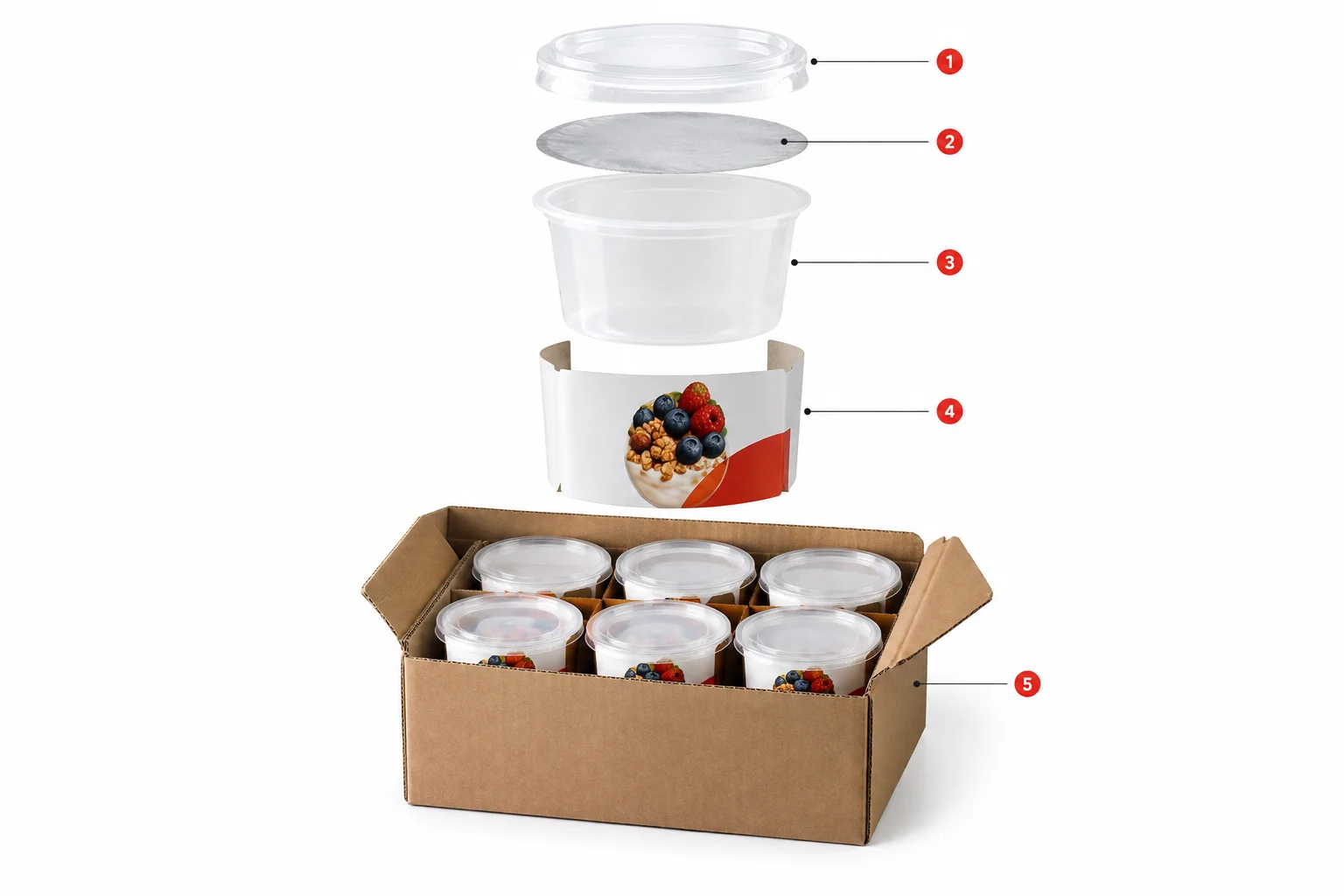
Hypothetical example: a UK challenger brand sells a chilled dip in a plastic pot with a film seal, a lid and a printed sleeve, shipped in a delivery case. We will follow this pack through the rest of the guide.
Checking whether your business is an obligated producer
Whether you report depends on your turnover and your packaging tonnage, which are tested together, and on what your business actually does with the pack. The checks below cover most of it.
- UK establishment. Is the business established in the UK?
- Turnover. Is worldwide annual turnover £1 million or more? Below £1 million, there is no obligation, whatever your tonnage.
- Tonnage. Did you supply or import more than 25 tonnes of packaging in the UK last year? For 2026 reporting, that means 1 January to 31 December 2025.
- Activities. Do you supply filled packaging under your own brand, pack or fill it, or import goods in packaging?
- Legal entity. Which company, subsidiary or group actually carries out each of those activities?
The two tests set your size. Turnover of £1 million or more with more than 25 tonnes makes you a small producer. You become a large producer when turnover is £2 million or more and packaging exceeds 50 tonnes. A £3 million brand on 40 tonnes is still small, and a £1.5 million brand on 60 tonnes is too.
Being a producer does not mean you carry every cost the scheme can charge. Small and large producers have different duties, and reporting is a separate thing from paying fees.
Outsourcing does not settle who is responsible either. If a co-packer fills your pots, the brand owner is generally the one who reports. Importers and packers can still pick up obligations, depending on where the brand owner is established and its size. It is a mistake to assume the packaging supplier handles all of it.
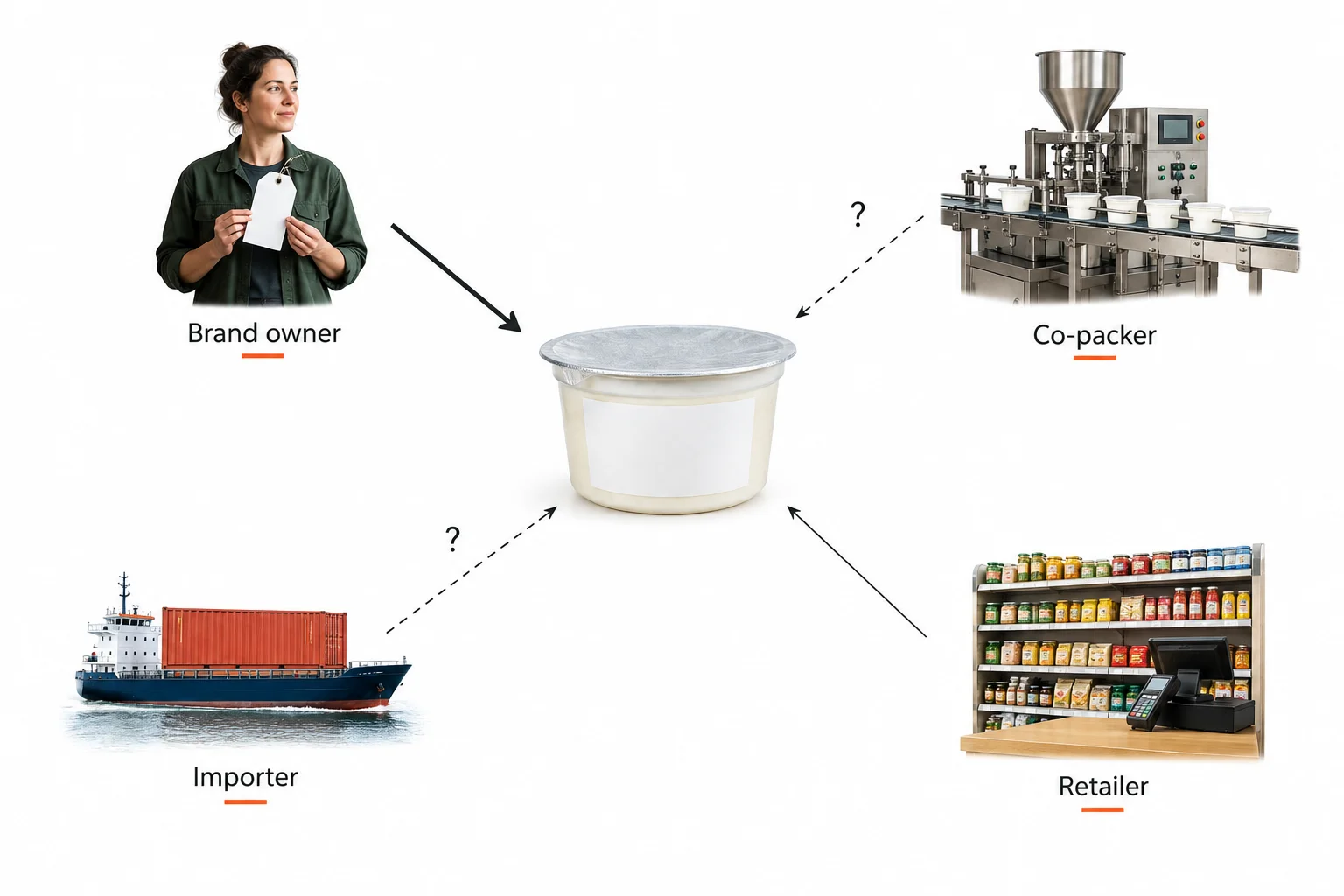
Hypothetical example: before deciding anything about the dip brand, you would need to know which entity owns the brand, its turnover, the 2025 tonnage across every component, and who fills and imports each part. Until you have those facts, you cannot say whether it is obligated.
The law does not require it, but it is good practice to write down who does what with your suppliers once you have the answers.
What packaging EPR asks of producers now
As of November 2026, packaging EPR is live. Registration, data reporting, recycling obligations and disposal fees are all operating, and the dates ahead are recurring deadlines.
| Requirement | Who it applies to | Timing |
|---|---|---|
| Registration | Large producers, annually | Report changes to your details within 28 days |
| Packaging data | Small producers | Annually: 2026 data due 1 April 2027 |
| Packaging data | Large producers | Six-monthly: 1 October 2026 for January to June, 1 April 2027 for July to December |
| Recycling obligations (PRNs or PERNs) | Large producers only | 2026 obligations met by 31 January 2027 |
| Household waste-disposal fees | Large producers | Annual. PackUK plans to issue the first 2026 to 2027 liability notice by the end of November 2026 |
| Recyclability assessment (RAM) | Large producers paying fees | Packaging rated red, amber or green, with fees adjusted accordingly, from 1 April 2026 |
Large producers whose only activity is selling filled packaging directly to the end user have a deferred registration deadline of 1 April 2027. Deadlines do move, so use the official GOV.UK guidance linked above as your working calendar.
Build your packaging record one component at a time
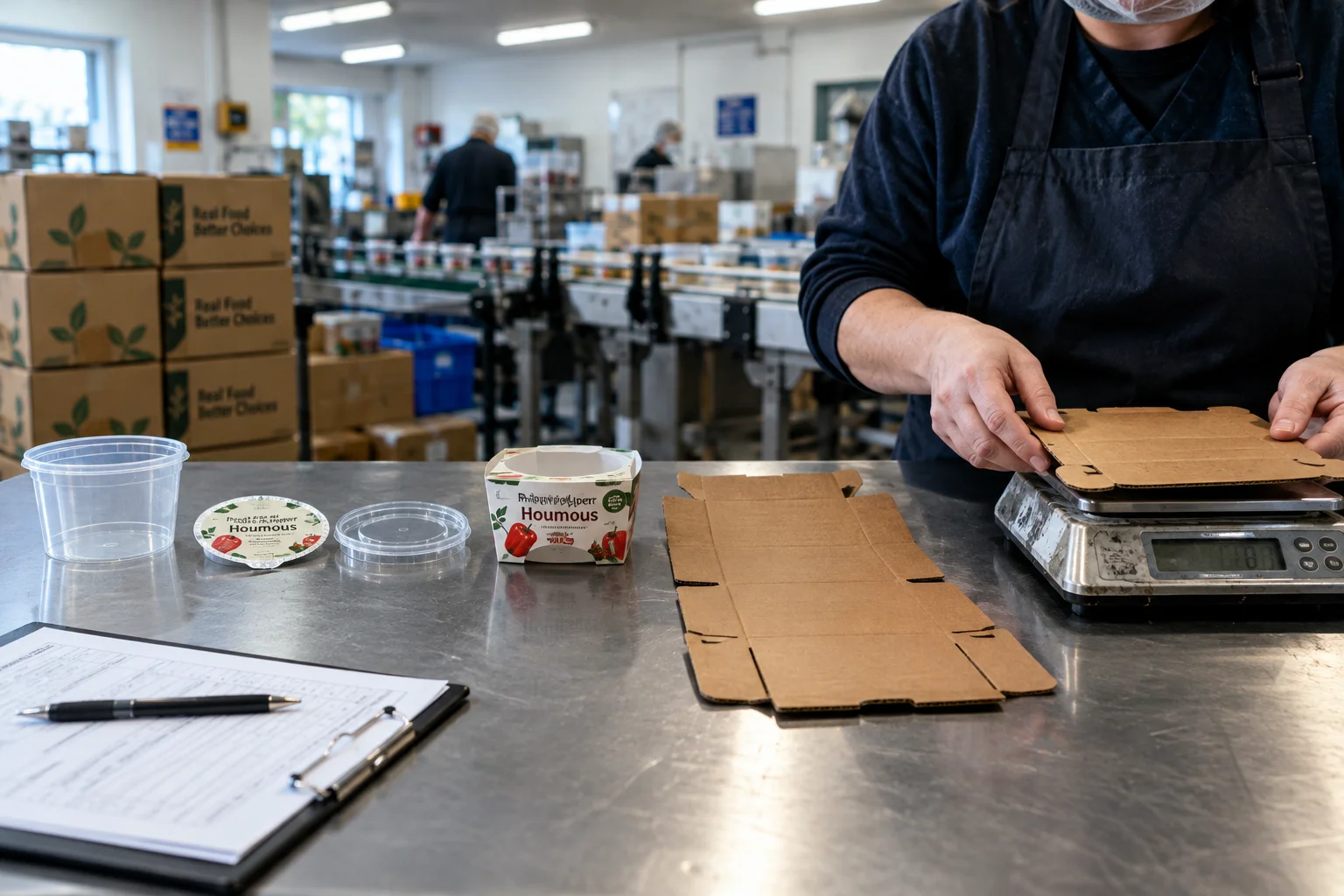
Your EPR record should list every packaging component separately. Large producers report the weight and material of each component separately, in kilograms, alongside packaging activity, class and household status.
Take the hypothetical dip. One sales unit is a pot, a film seal, a lid and a printed sleeve, so four components, each with its own material and weight. The corrugated delivery case holding several units is a fifth. Multiply each component’s weight by the units supplied and you have the core of the record.
Ask your suppliers for this:
| Field | What to request |
|---|---|
| Component description | Pot, seal, lid, sleeve, case |
| Material or composition | Base material plus food-contact layers, coatings, labels and adhesives |
| Weight | Measured unit weight, marked as measured or estimated |
| Specification version | Spec number and date |
| Supporting evidence | Spec sheet, weighing records or test reports |
Get the composition detail while the supplier is already answering, because it feeds the recyclability work in the next section.
Keep two classifications apart. Primary, secondary and tertiary describe what the packaging does, while household or non-household describes where it ends up. If you can’t evidence non-household status, it must be reported as household, and evidence should be kept for at least seven years.
Working fields such as SKU, supplier contact and sales volumes help you build the report but aren’t necessarily statutory. Producers do need to keep their calculations and quality checks.
Give one person ownership of the record and log every specification change. A lighter lid or a new sleeve stock changes the data, and that change belongs in the record before the artwork goes to repro. Our guide to UK packaging regulations covers the wider rules.
Brief recyclability as a design constraint backed by evidence
Your packaging brief should ask for evidence about each component, and it should stop asking for “a recyclable pack”.
The scheme sets the starting point. Recyclability assessments give a red, amber or green outcome, and components are assessed separately only when they are easily separable by hand. PackUK’s RAM 2027 materials guidance adds specific triggers. A sleeve of a different material covering more than 60% of a rigid plastic pot is amber at sortation. A label adhesive that won’t release in a 70 to 90°C hot wash makes the item red. From 2026 to 2027, disposal fees are modulated by recyclability, so the rating can feed into the bill.
Back to the hypothetical dip. A pot specified as “PP” tells you little on its own. The seal’s layers, the lid’s colour, the sleeve’s material and coverage, and whether a shopper can peel it off cleanly all count.
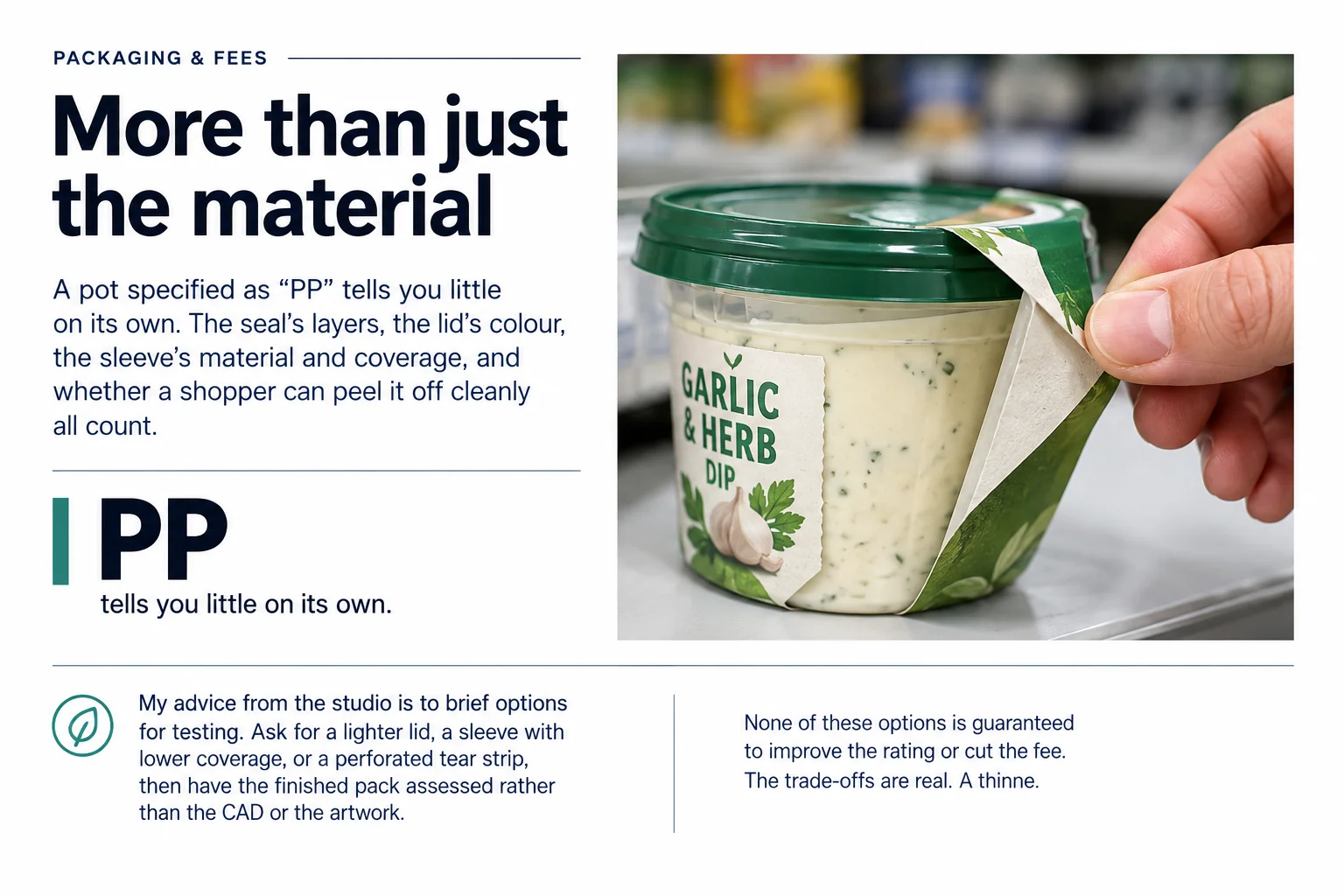
My advice from the studio is to brief options for testing. Ask for a lighter lid, a sleeve with lower coverage, or a perforated tear strip, then have the finished pack assessed rather than the CAD or the artwork. None of these options is guaranteed to improve the rating or cut the fee.
The trade-offs are real. A thinner pot can split on the filling line. A smaller sleeve gives up front-of-pack space your shoppers use to find you. A weaker seal shortens shelf life and wastes product, and that costs more than any packaging fee.
Plastic Packaging Tax needs its own evidence
Plastic Packaging Tax and EPR are separate regimes, and passing one tells you nothing about the other.
Plastic Packaging Tax is an HMRC tax on certain plastic packaging components. It turns on who manufactures or imports them and whether they contain at least 30% recycled plastic. EPR covers packaging data, producer obligations and, where they apply, disposal fees and recyclability assessment. A business can need to assess both.
Take the hypothetical dip pot again. A supplier certificate proving 30% recycled content may take that pot out of the tax charge. It does not give you the material, weight and packaging class you need for EPR reporting. It also does not show whether the sleeve and seal will pass a recyclability assessment, because that assessment measures recyclability, not recycled content.
So ask suppliers for both sets of evidence, and file them separately. Food-contact suitability and on-pack labelling are separate checks again, each with its own paperwork.
Six things your next packaging brief should cover
Use this as a working brief for your team. The statutory detail sits in the GOV.UK guidance.
- Check applicability against the official turnover and tonnage tests.
- Name the responsible entity, the person who checks and submits data, and what any compliance scheme will handle.
- Collect material, weight, format and packaging class for every component.
- List missing or estimated supplier evidence and chase it.
- Record constraints such as food contact, shelf life, line speed and print process.
- Agree who runs the recyclability assessment, and which changes trigger a review of the record.
A design brief is not legal assurance, so take unclear obligations to your regulator or a compliance adviser.
Sources
- Extended producer responsibility for packaging — Department for Environment, Food & Rural Affairs and PackUK
- Check if you must comply with EPR for packaging – GOV.UK — Department for Environment, Food & Rural Affairs and Environment Agency
- UK Packaging Regulations in 2025: Essential Compliance Guide for Brands — Gouldingmedia
- Check what to report for EPR for packaging as a large producer – GOV.UK — Department for Environment, Food & Rural Affairs, Environment Agency and PackUK
- Extended producer responsibility for packaging: Regulators’ agreed positions and technical interpretations — Environment Agency, Natural Resources Wales, Northern Ireland Environment Agency, and Scottish Environment Protection Agency
- Deadlines for registration and packaging data reporting – GOV.UK — Department for Environment, Food & Rural Affairs
- How to register for EPR for packaging as a large producer — Department for Environment, Food & Rural Affairs
- How to comply with packaging recycling obligations as a large producer — Department for Environment, Food & Rural Affairs and Environment Agency
- Waste disposal fees for large producers under EPR for packaging — PackUK
- PackUK operational plan: 2026 to 2027 — PackUK
- Extended producer responsibility for packaging: how to assess household and non-household packaging – GOV.UK — Department for Environment, Food & Rural Affairs, Environment Agency and Natural Resources Wales
- Record and submit your methodology for collecting packaging data – GOV.UK — Department for Environment, Food & Rural Affairs and Environment Agency
- Recyclability Assessment Methodology (RAM): package of support — GOV.UK
- Recyclability assessment methodology: supplementary guidance – GOV.UK — PackUK
- RAM 2027 materials assessment guidance – GOV.UK — PackUK
- Extended producer responsibility for packaging: modulated disposal fees — PackUK
- Plastic Packaging Tax: steps to take – GOV.UK — HM Revenue & Customs
- Check which packaging is subject to Plastic Packaging Tax – GOV.UK — HM Revenue & Customs